
Understanding the Export Loading: From Cargo Staging to Container Sealing
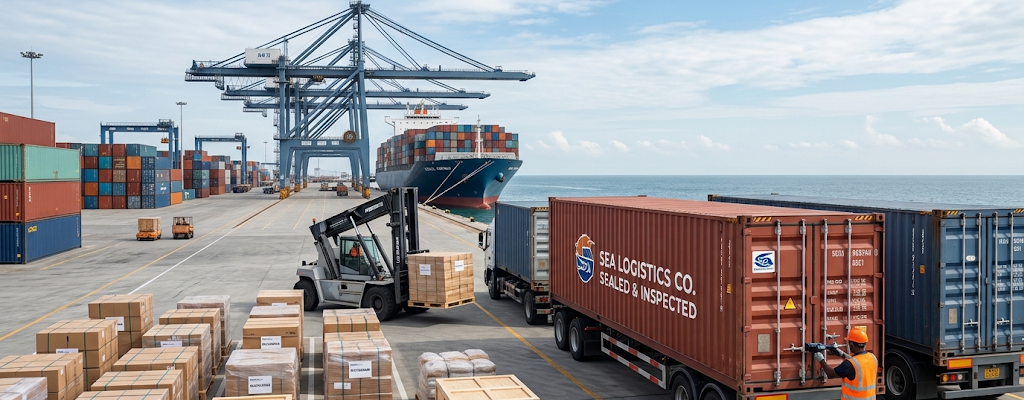
Container loading is a very important thing. Not doing this correctly would lead to damaged goods and sometimes, claims that can take months to settle. Problems like this must be catered to in the beginning itself – even before the ship sales. This guide by AL Dana is aimed at exporters and freight teams who use container loading services.
What Is Container Stuffing in Export Logistics?
Container stuffing, also known as container loading, is the process of loading cargo into a shipping container. It also covers the arranging, securing and documenting the cargo for shipping. Not all exporters need a container loading team because they do it at their own warehouse. But if the cargo is from multiple locations or the exporter does not have any loading equipment then you will have to get the experts.
Receiving and Verifying Cargo Before Loading
It is important to verify the cargo when it arrives at the dock. Here’s what needs to be verified and checked with the packing list:
- The count, markings and condition of each item
- Their size and weight
- If any goods are damaged, then it will be noted with photos before loading starts
It is important to take photos because if something is damaged prior to the goods reaching the loading dock.
Preparing Cargo for Container Stuffing
Before the cargo is placed inside the container, it should be packaged, labelled and strapped well. ISPM 15 treatment and mark is required for wooden crates and pallets for export. Check for this early, at the staging area, and not at the port. Another important step before placing the cargo would be to group the cargo in loading order, so the loading happens smoothly.
Inspecting the Container Before Loading Begins
The container has to be checked thoroughly before anything is loaded inside it. The floor has to be clear of holes, with no damp patches and the doors close and lock properly. There must be no smell or residue from the previous cargo. There is an international CTU Code which is a code of practice for packing containers that loading companies have to follow.
Positioning Cargo for Efficient Loading
Carefully planned loading is important. The weight should be distributed across the floor and not piled at one end and loose at the other. Also, the heavier goods will be placed first and the other spilled on top. An expert loader will use the space well. Their loading will make unloading easier too.
Handling Palletised, Crated, and Loose Cargo
The method for cargo loading will vary according to cargo type. Palletised goods will be loaded carefully with forklifts or pallet jacks and no overhang. Loose cartons should be stacked with gaps so the lower cartons can support the weight. Lifting points of crates should be correct and should be placed in the correct position. This will help unloading to be easier.
Securing Cargo to Prevent Movement During Transit
Whether it is on the road, sea or by air, transportation could cause the goods to shift. And so when at sea, the container will be lifted, driven, braked and rolled by. This is why securing the cargo with straps, chains and timber is so important.
Verifying Cargo Quantities and Shipping Documents
Count the cargo on the packing list and mark them off as they go in one by one. Next, review the documents. Shippers will not accept a container without the verified gross mass (VGM) of the container in the shipping documents. This is a rule by SOLAS that came in on 1 July 2016 and has to be diligently followed. The VGM can come from weighing the packed container, or from adding the weight of the cargo, packing material and the container’s own weight.
Final Inspection Before Container Sealing
A supervisor will walk through the container. They will look at the lashing, check for gaps and make sure everything is loaded correctly. And nothing leans on the doors. Take photos of the finished load.
It is also very important to record the container number and the seal number. Taking a photo of both would help too.
Common Issues That Can Delay Container Dispatch
Avoid these delays when loading the cargo
- Missing or mismatched documents
- No VGM, or one submitted late
- When a container gets rejected for damage
- Wooden packaging without the ISPM 15 mark
- No proper equipment for loading
- Poor planning in loading
Why Choose Al Dana's Professional Services for Container Loading?
Al Dana Al Dahabeya specialises in heavy machinery and industrial equipment, palletised goods, loose and fragile items as well as container unloading. We follow a four-step process: cargo assessment, a load plan, loading and securing, and a final check by the supervisor. We use cranes, forklifts, reach stackers, pallet jacks and provide forklift rental or mobile cranes for rental. Our container loading service serves clients in manufacturing, automotive, construction, oil and gas and retail and FMCG, and are familiar with the processes in Jebel Ali Free Zone.
Conclusion
Successful cargo loading should be done by experts in the field to ensure everything happens on schedule. To plan your next export loading, call +971-50-860-7636 or email info@al-danagroup.com.

Contact Us
Muhammed Rashid Transport & Logistic Specialist TMA REGION (Middle-East & Africa) MOB: +971-50-860-7636